When you travel to the Philippines in the wet season, you have to be prepared for the possibility that your plans may be scuppered. We were lucky – each torrential downpour that punctuated our day trip conveniently occurred when we were under cover. Nevertheless, this tiny taste of extreme weather gave us a tangible awareness of what it means to live in the country that for years has topped the natural disaster World Risk Index. Yet, amidst stories of crop devastation and building destruction not a trace of self-pity – only a desire to rebuild and move forward, to mitigate and motivate.
Subtitle for This Block
Title for This Block
Text for This Block
The Accidental Farmer
Our first stop is Vientos della Granja, the clouds indulgently pausing literally moments before our arrival, giving us the opportunity for a full tour. Set next to endless fields of sugar cane, the farm offers a curious change of scene. Rows of planting beds, a variety of trees, shrubs and flowers, and a spacious greenhouse-come-nursery. Our guide is Doctor Anabel Villanueva, definitely not your typical local farmer. Having moved to the USA to pursue her career in medicine, she returned temporarily in 2012 to take care of her 93-year-old mother, “and she passed away a week shy of 101!”. Anabel brought home a mix of memories and desires that have evolved into this new chapter which is, as she describes it, both challenging and gratifying.
Missing the fresh, organic vegetables she could get so easily in the US, she planted her own kitchen garden in her mother’s backyard. Soon she had so much surplus produce she started giving it away, then selling it affordably-priced locally, and then giving it to her chef cousin to cook for the poor. She calls it her grandfather’s legacy – he was a farmer who cultivated rice, vegetables and fruit, not just sugar cane, and sent weekly baskets of fresh produce to his children.
It was soon clear she needed more space, “I told my brother, I don’t want to plant sugar cane, I want organic vegetables!”. Going organic amidst fields of non-organic sugar cane isn’t easy. And convincing local farmers to halve their yield by switching to organic sugar cane is a battle yet to be won.
So Anabel started with a water barrier around her 2.7 hectares, and trees – hundreds of bamboos. They now have fruit trees including native ones like pili nut and santol (cotton fruit). They grow aubergines, okra, tomatoes, kale, spinach, rocket, bok choi and gourds. They have mango, durian and more than 270 criollo cacao trees, acquired from their friend, Christopher Fadriga, whose beans are internationally prize-winning. They keep native pigs, goats and chickens which are the basis of Bacolod’s signature dish chicken inasal – marinated chargrilled native chicken.
When Typhoon Tino Hit
As we walk, Anabel explains how they do integrated farming, mixing Korean, Japanese and JADAM farming systems. They make their own fertilizers, soil enhancers and natural pesticides, and have solar-powered water pumps.
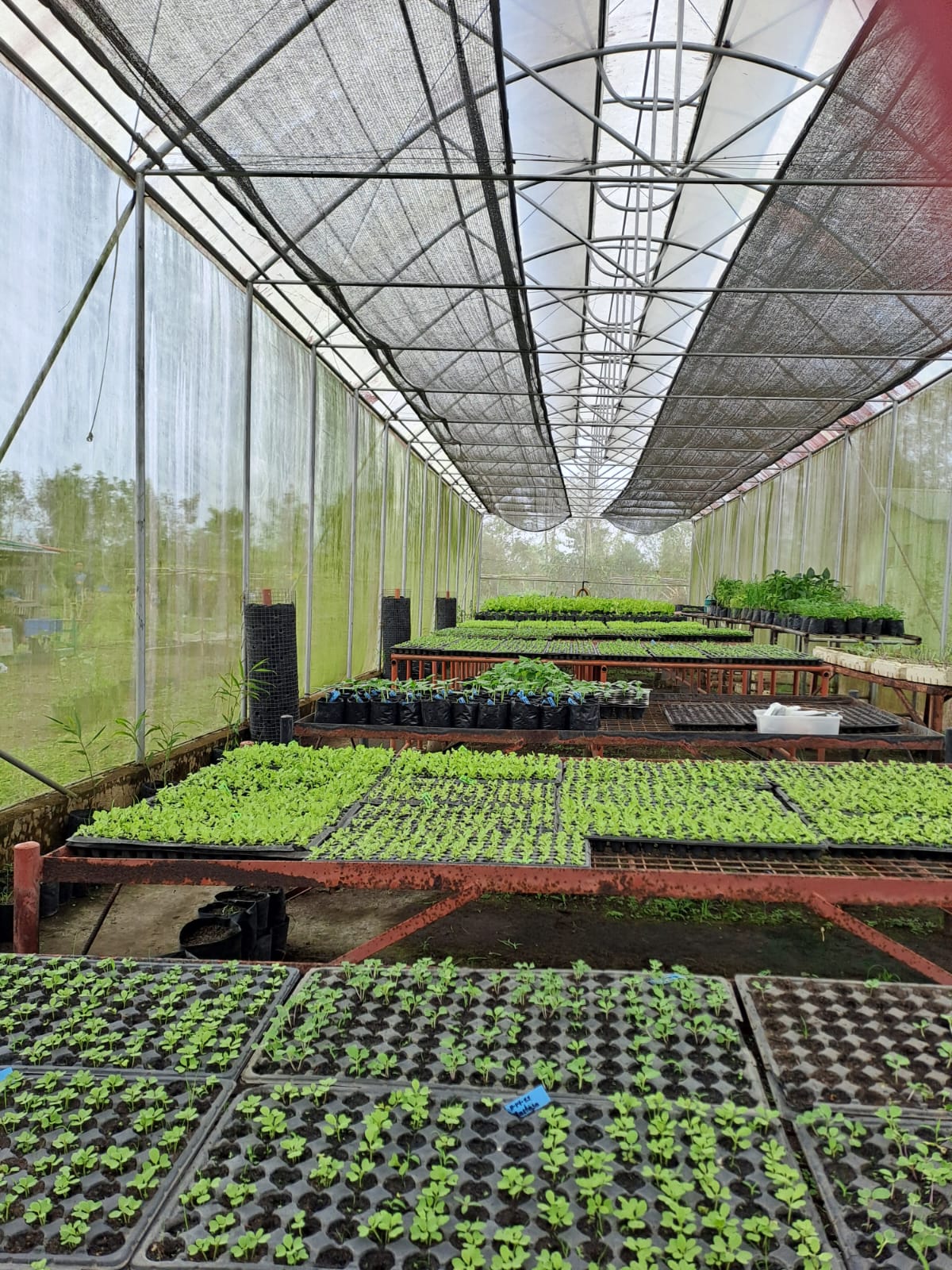
But the lettuce is dead, the vegetable beds destroyed, and all the banana trees are gone – victims of Typhoon Tino which hit two weeks prior to our visit. “For me, the biggest challenge right now for farmers, it’s not pests, it’s not the use of fertilizers, it’s severe weather”, says Anabel, explaining how much worse it has got compared to her childhood growing up here. But unlike many who complain about the devastation the cyclones bring, Anabel looks for – and finds – solutions. As a retired doctor, she believes in “trying to be broad spectrum, like an antibiotic!” You can’t just be resilient, she says, you have to adapt. She’s been studying the wind and its direction. “This area, it’s called Vientos de La Granja, meaning ‘winds of the farm’ because this is always where the wind crosses over. You can’t withstand 200 km per hour wind unless you work with it.” She’s planning to reorient her vegetable beds and build more structures like her nursery-come-greenhouse, the only one left standing. Expensive, she says, but worth it, “It’s made of mesh so pests can’t get in and the wind passes right through it”. The banana trees came down but they protected the cacao, still thriving and now sturdy enough to withstand future winds. “We’ve learnt valuable lessons, like prune your trees when a storm is coming.” One Italian visitor in our group says they do the same to prepare for the snow – some practical methods are truly universal.
We walk a little further and Anabel points to their Hügelkultur – where fallen trees are transformed into compost mounds then covered with soil and planted on. “Some people burn their fallen trees. I don’t allow it; that’s pollution. And it’s material that I can use on the farm, it’s organic matter. Why would I waste it by burning it?”
As well as tourist groups like ours, they invite city children from Bacolod to do farm activities here. And they’ve also opened an organic restaurant, 26 Herb Garden, where her cousin, Joeri Arro, cooks traditional local specialities using their produce.
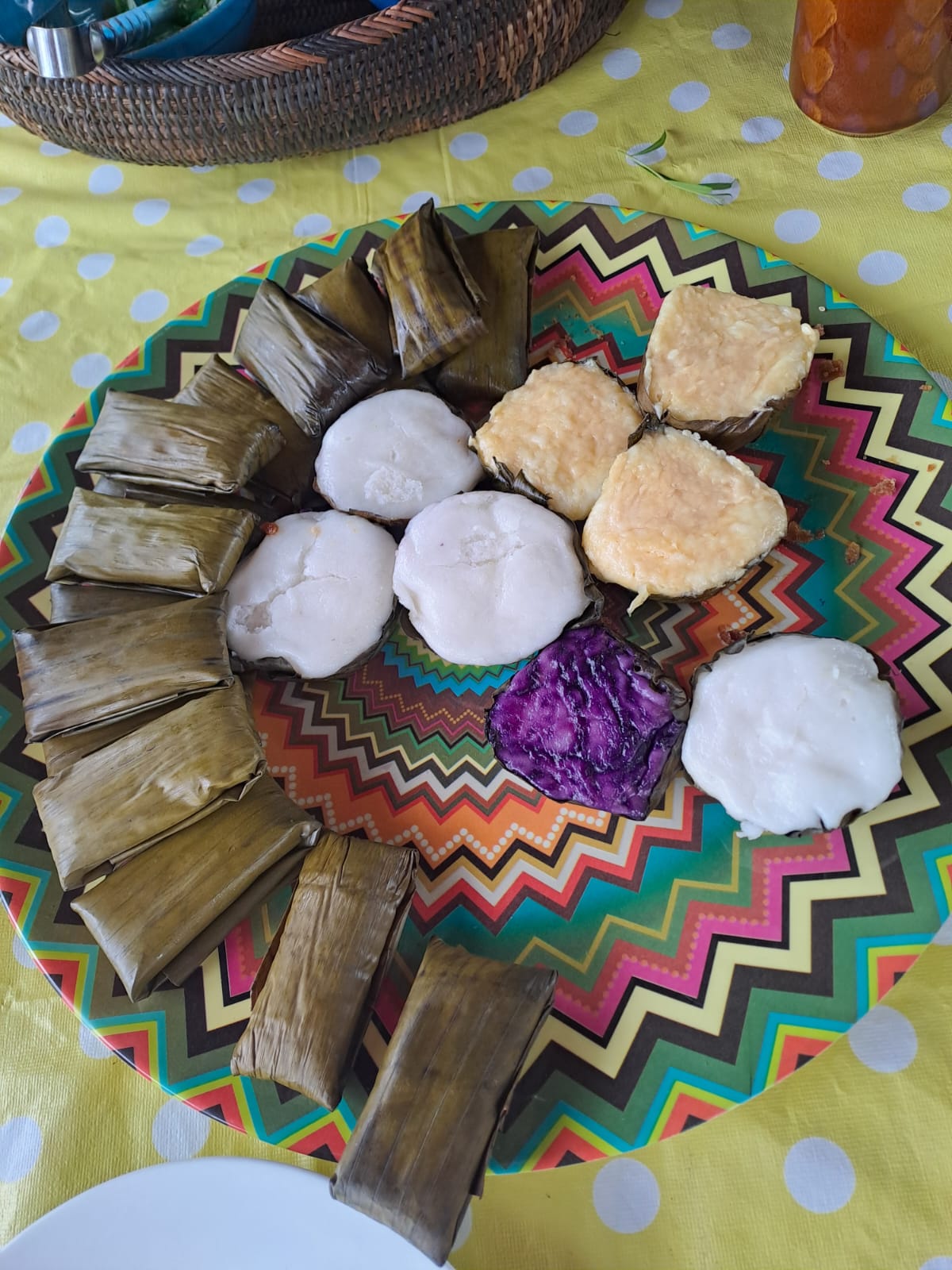
Before we leave for the coffee trail, we’re invited to have some refreshments. Joeri, indicates 3 ceramic bowls, each containing an ingredient for us to create our own herbal infusion: bright orange slices of fresh turmeric, vibrant green mint and slender tarragon leaves, all grown literally a few steps from us. I pour the hot water onto my selection and inhale the fragrant steam. There’s a plate with an array of local snacks: different coloured round puto (Filipino steamed rice cakes) in the centre, and alupi – little rectangular parcels – arranged in a fan around them. Anabel explains that alupi is made with finely ground cassava flour mixed with a little bit of brown sugar and young coconut which is wrapped in a banana leaf and steamed, “Please taste it! This is our pride and joy!”. The sweetness and texture are perfect. I can’t resist tasting the purple puto too: ube and coconut. Its delicate flavour goes spectacularly well with the aromatic tea.
And then it’s time to say goodbye and set off for our next destination.
Sugar Valley
The sky is threateningly overcast as we drive through lush green hills to our next destination: Teddy Cañete’s farm, Sugar Valley. We arrive and are led along a path to a large covered open-air reception area with breathtaking views across the misty valley below. Teddy smiles with satisfaction as we admire the panorama; he points to the top of the hill where he was born and raised until the military moved the family down here during the insurgence. Transport and access to schools is easier from here so they stayed.
Teddy is an indigenous, third generation coffee farmer; a proud member of and local spokesperson for the Slow Food Coffee Coalition. He tells his story with a matter-of-fact eloquence, a tale of land for the landless, a struggle with the government for tenure rights, and a final victory in the form of a certificate of land ownership little over a decade ago. Today Teddy wants to tell us above all about the happiest chapter… but first we must taste his coffee!
The table is piled high with a selection of sweet treats made by the local community: banana and chocolate chip cup cakes, sticky rice and cassava cakes. The coffee is extraordinary – smooth, chocolatey and naturally sweet. Teddy says the flavour is given by the cacao trees on his farm during pollination, “This is the thing we call biodiversity”.
As we sip and nibble, Teddy talks. He tells us how things were and how they are now. In the past, they would pick the coffee cherries – or berries as he prefers to call them – and sell them to traders. The traders said their quality was very low and paid so little that farmers couldn’t cover their own labour costs. But then Teddy was introduced to the Coffee Coalition. “What I am now is because of Slow Food”, he says earnestly. The opportunity to meet and exchange information with coffee professionals, aficionados and farmers from other parts of the world has, Teddy says, changed his life. He has learnt how to select and process his beans and has turned coffee into a valuable resource. Even the simplest advice, like ‘wash your beans in clean water’ has had a huge impact on quality. “Knowledge is caring”, he puts it simply, explaining how the coffee coalition taught him that he needed to understand his product to argue its value. “It’s really boosting to my confidence in pursuing my plan to continue educating my fellow coffee farmers.” There are now 42 farmers in the Minoyan Murcia Marginal Agriculture Cooperative who have learnt to commercialize so they can cut out the middleman and sell directly. They aren’t officially certified organic, instead they use the Participatory Guarantee System among the local farmers. The cost of official certification, says Teddy, can go towards education or employing extra staff. “I can still sell my coffee in the coalition. Just taste it! This coffee is really good, clean and fair.”
As we sip and nibble, Teddy talks. He tells us how things were and how they are now. In the past, they would pick the coffee cherries – or berries as he prefers to call them – and sell them to traders. The traders said their quality was very low and paid so little that farmers couldn’t cover their own labour costs. But then Teddy was introduced to the Coffee Coalition. “What I am now is because of Slow Food”, he says earnestly. The opportunity to meet and exchange information with coffee professionals, aficionados and farmers from other parts of the world has, Teddy says, changed his life. He has learnt how to select and process his beans and has turned coffee into a valuable resource. Even the simplest advice, like ‘wash your beans in clean water’ has had a huge impact on quality. “Knowledge is caring”, he puts it simply, explaining how the coffee coalition taught him that he needed to understand his product to argue its value. “It’s really boosting to my confidence in pursuing my plan to continue educating my fellow coffee farmers.” There are now 42 farmers in the Minoyan Murcia Marginal Agriculture Cooperative who have learnt to commercialize so they can cut out the middleman and sell directly. They aren’t officially certified organic, instead they use the Participatory Guarantee System among the local farmers. The cost of official certification, says Teddy, can go towards education or employing extra staff. “I can still sell my coffee in the coalition. Just taste it! This coffee is really good, clean and fair.”
“Make a better Teddy”
Teddy believes his connection with Slow Food has made him a better person. He has learnt that there is money to be made in producing top quality coffee. He has paid for his daughter to finish her education and acquired more land. And he has also learnt how doing things the right way can contribute to caring for nature and the environment and preserving biodiversity. That’s why he has built a dormitory for trainee farmers to come to learn here. And now Slow Food Travel is opening more new paths, “I’m very, excited. It’s another opportunity to engage, to connect, to make a better Teddy!” he grins.
Visitors to the Sugar Valley coffee experience can choose from four official trails: easy, intermediate, advanced, extreme, and an unofficial fifth one, ‘the Spartan trail’. By now the rain is pelting down, leaving those who wanted to do a long trail disappointed and me, not the best at outdoor activities, secretly relieved. Teddy indicates areas of the hills across the valley as he describes each one. The intermediate takes 1.5 to 2 hours; advanced takes 2 to 2.5 hours and goes 800 metres above sea level; extreme takes four hours, “our Arabica coffee is there”; and for diehard hikers, the 5 hour Spartan trail takes you to the highest part of Teddy’s property, where his family used to live, “It’s a very historical area. There are some 120-year-old Liberica and Arabica coffee trees up there”. Teddy encourages visitors to push themselves to choose a challenging trail so they can appreciate how hard coffee farming is. He tells us that when he first started processing and selling directly, some people complained about the high price. His answer was “Okay, join me. We can walk 4 kilometres, you can carry the sack of coffee and we’ll talk about it later.” The ones who did it came back exhausted. “That’s our daily experience. The price you pay compensates for all the effort because, if we cannot find economic value in our product, maybe we’ll just cut the trees and sell them as charcoal. That’s why this coffee trail is so important.”
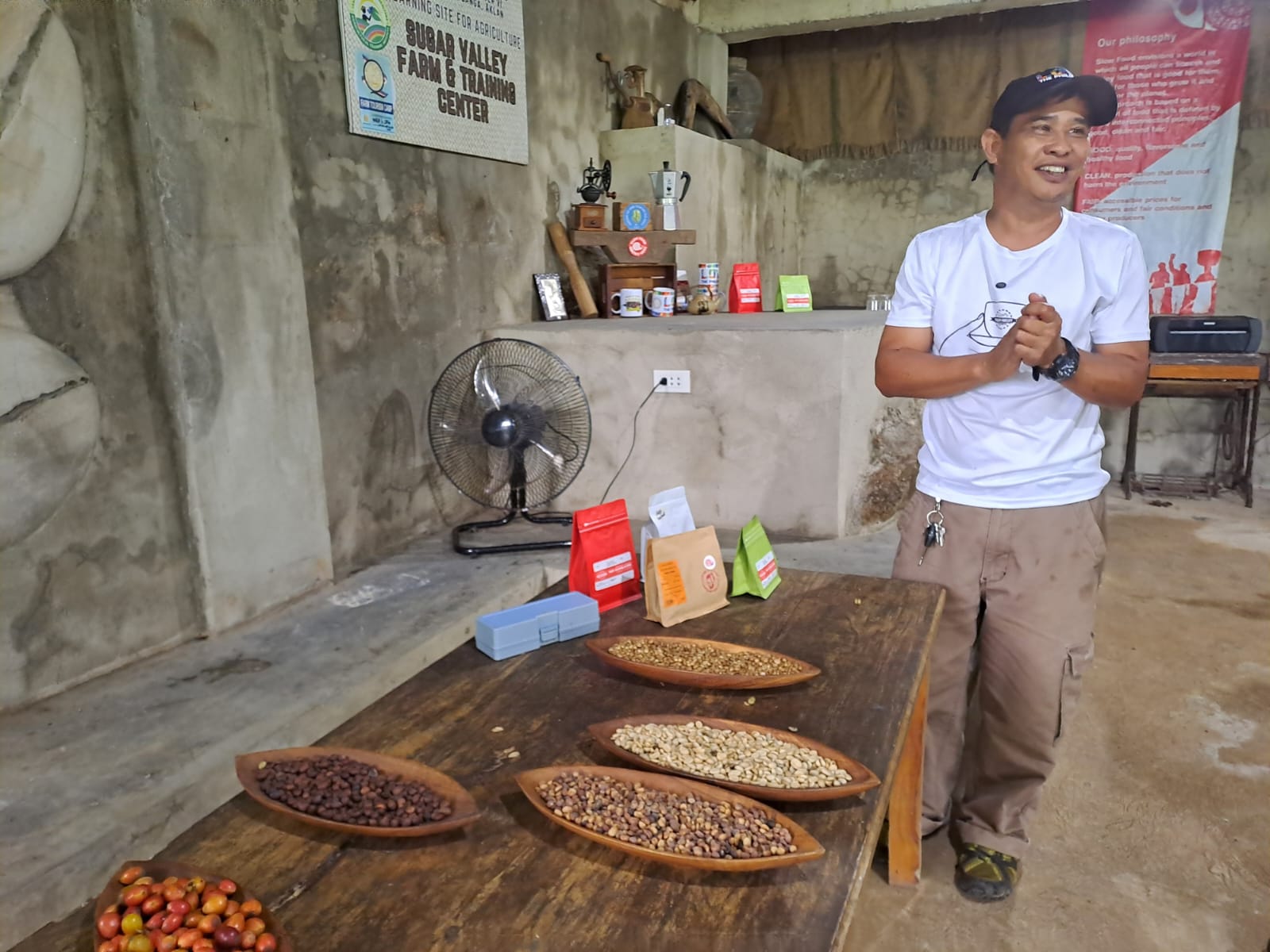
But the trails are about much more than walking and admiring the landscape and even the easy trail gives visitors a rare chance to learn. Teddy has bowls of berries and beans to show us the three types of coffee he grows: Liberica, Arabica and Robusta. We see where they do each step of the process by hand: from selecting the perfectly red, ripe berries to washing, drying, hulling, fermenting, sorting and roasting. Nothing is wasted – imperfect berries or beans simply become lower graded cheaper coffee.
As we walk amidst the trees, Teddy explains the impact of climate change, showing us a single branch with a mix of red, orange and green berries. The fruits, he says, no longer ripen in a uniform way. In the past they could visit a tree just once to harvest, now they have to visit the same tree at least six times. Severe droughts and typhoons are a constant threat but Teddy uses the principles of agroecology, retaining old tall trees as natural protection to mitigate the effects. When Typhoon Tino hit, the damage to his coffee was very limited, “I can’t imagine without these tall trees what would happen to my farm. All my berries would be on the ground and once they touch the ground, that’s it.”
A Filipino Farm Feast
Lunch has been cooked by fellow farmer and guide, Dennis Peruelo and his wife. “All the food that we serve, we gather in this community”, he says, reminding us that the positive impact of tourist visits goes beyond Teddy’s coffee trail. Dennis explains each dish with a huge smile on his face. Native chicken adobo; pork with jackfruit, papaya and batwan, a local fruit used as a souring agent; water spinach, which grows wild around the edges of the rice fields, made with onions, vinegar and sugar; my favourite: ensalada made with jackfruit, tomatoes and onions; “and the last dish is rice, obviously”, Dennis giggles. For dessert, there’s fresh juicy mango, water melon, pineapple and baby bananas. “We are so blessed,” says Teddy, “Whatever happens, we still have food to eat here in the mountains.” We too are blessed, I think, my tummy happily full.
Having purchased packets of coffee as the perfect pasalubong (Filipino souvenirs), we sign Teddy’s ‘vistors’ wall’ and set off back down to Bacolod as the rain gets even heavier.
From one wall to another
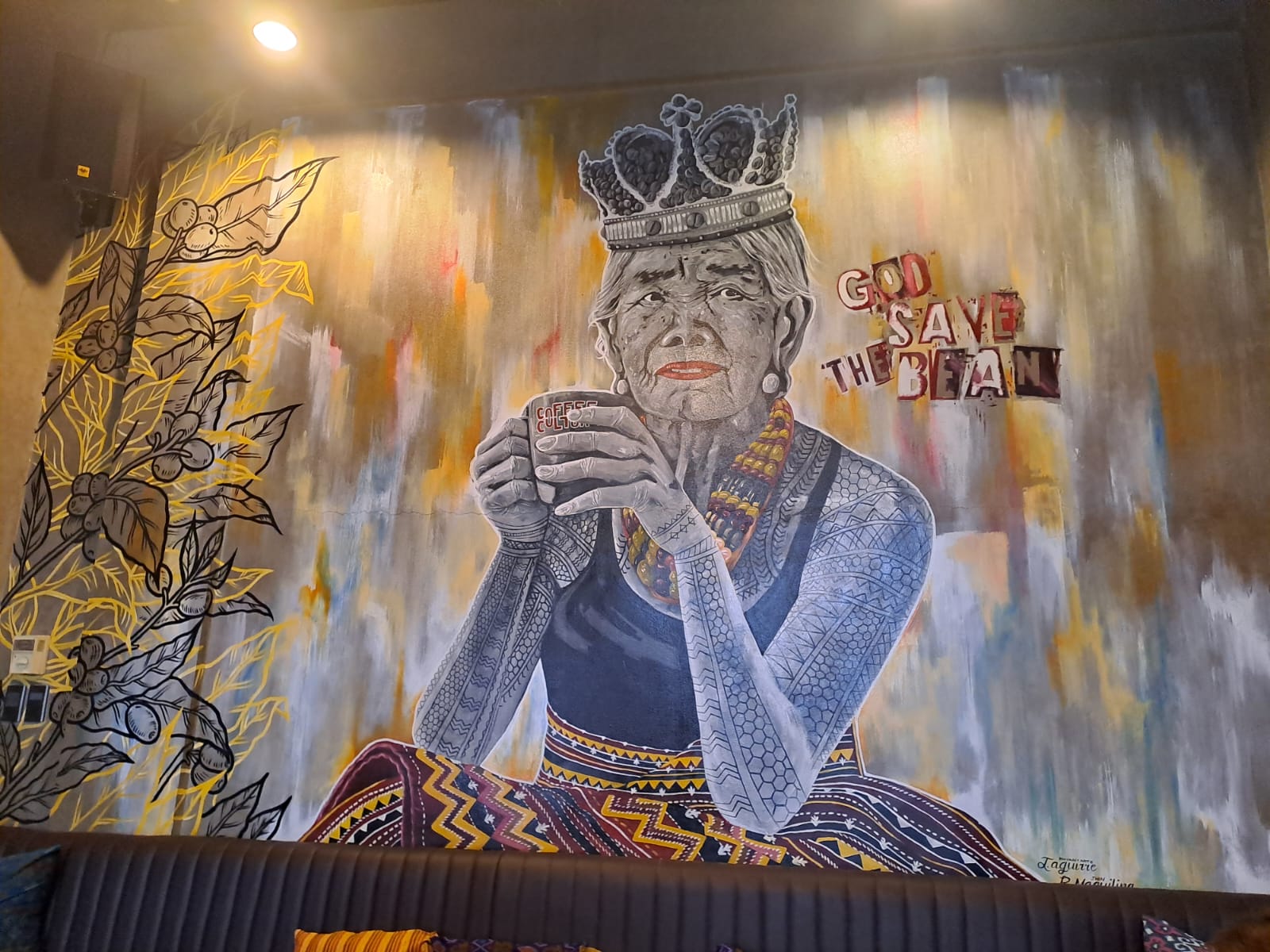
In Bacolod we find another unusual wall – this time at Coffee Culture Roastery. It’s the brainchild Thomas Sproten, “German by birth, Filipino by choice”, who decided to use coffee grounds to decorate his café. The colour is a warm shade of milk chocolate gelato, an understated tone leaving the spotlight on the back wall: a Sex Pistols-inspired mural bearing the slogan “God Save the Bean”. Thomas describes himself as “a bridge between the farms and the coffee-loving population in the cities”. He has been working hard to help Filipino farmers like Teddy produce top quality coffee and achieve the respect and recognition they deserve. The wall for Sugar Valley’s visitors to sign was his idea.
Upstairs, Thomas has a special room which is where we are treated to a fascinating and fun end to a day of exploration and discovery. We’re learning the basics of coffee cupping. Coffee cupping is a way of evaluating the smell and taste of coffee, and we’re learning from the best. Thomas is the first Q and R grader (the coffee equivalent of a wine sommelier) in the Philippines and a phenomenal teacher. We’re tasting a selection of Filipino coffees, one of which is Teddy’s. We learn the difference between fragrance and aroma; how to discern with your nose and your mouth, pushing your senses somewhere they may not have been before. We discover flavour wheels and the four major aromatics you can pick up as a beginner: chocolate, nuts, fruits and florals. Thomas recommends being open to memories and associations the coffee might trigger. We practise a weird, sucking action through our teeth to spray coffee all over the inside of our mouths: onto the tongue receptors, gums and retro-nasal cavity. It’s not, he explains, about what you like or don’t like but what you perceive. It makes me laugh. Thomas says it makes the farmers laugh too. He’s excited about the future of Filipino coffee, encouraging farmers like Teddy to make the most of their precious beans. “I’m grateful to be part of this and have people come here and listen to the story and, above all, go to the farms, not just have coffee here. It’s about working together.”
The coffee cupping session perfectly complements the farm visit but it does take a lot of concentration, “If you do the longer trail, you probably just wanna take a shower,” says Thomas, a host who makes you feel like nothing’s a problem, “so I’m very flexible if people want to come here the next day.”
Dinner in Bacolod
Our group doesn’t need a shower, having had one during the brief race from our minibus into Coffee Culture but by the time we say goodbye to Thomas, the rain has abated. The last stop to round off the day trip: dinner at Lanai by Fresh Start, an organic restaurant serving farm-to-table dishes made with locally sourced produce. Carabao (water buffalo) burrata; lapu-lapu (grouper) in ginamos sambal; and, for dessert, piaya (small flat breads made with muscovado sugar). After our incredible coffee trail experience, none of us needs an after dinner espresso.
Click here for the original:
Published on the Slowfood.com blog, December 2025